In response to signals from the market, the Aruba Fair Trade Authority (hereinafter: the AFTA) conducted an investigation into payment card transaction fees in Aruba. These are fees that banks charge to retailers, restaurants, and other points of sale when customers pay with a debit or credit card.
The AFTA’s investigation shows that payment card transaction fees in Aruba are very high compared to other countries (including EU member states, the United States, and New Zealand).
The main cost component of payment card fees consists of interbank fees set by Mastercard and VISA, for the mutual execution and settlement of transactions for each other’s clients. For Aruban banks, these fees are many times higher than what is common in other countries. Due to these high interbank fees, the rates that Aruban banks charge merchants for debit and credit card payments are also very high.
The interbank fees of Mastercard and VISA are currently unregulated in Aruba, whereas in many other countries — such as the EU member states — maximum limits apply that are far lower than the rates applicable in Aruba.
The AFTA therefore makes several recommendations that will contribute to a reduction in these fees. The main recommendation is for Aruba to introduce regulation setting a maximum level for the interchange fees set by payment card companies, as is the case in many other jurisdictions.
General information
Card payments are very common in Aruba. Aruban commercial banks issue various types of payment cards, and merchants accept various global card brands. When an Aruban or foreign consumer uses a payment card to pay for goods or services, the Aruban merchant does not receive the full amount paid by the consumer.
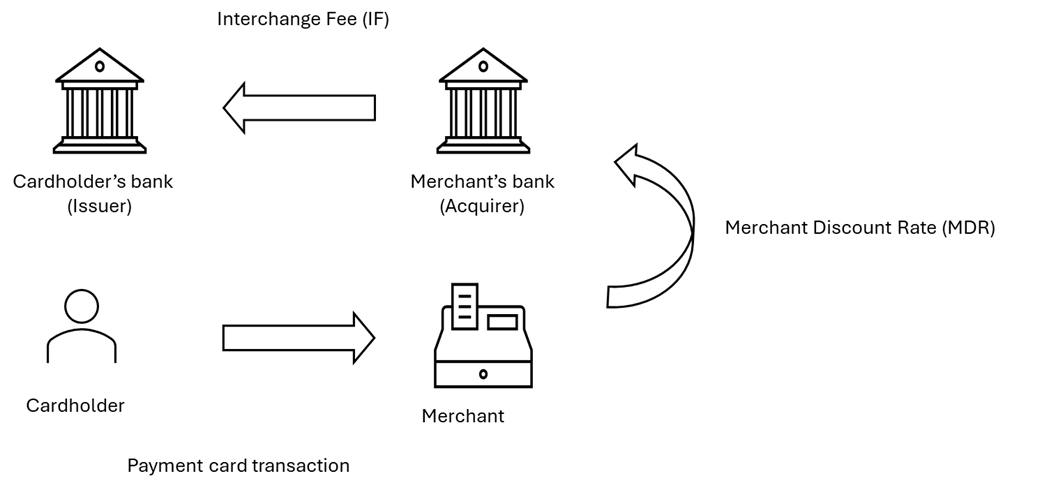
A share of the amount is withheld by the merchant’s bank (the acquirer) as the “Merchant Discount Rate” (MDR). The largest component of the MDR consists of the “Interchange Fee” (IF) which is set by the card schemes. The IF is an interbank fee that the merchant’s bank must pay to the bank that issued the consumer’s card (the issuer) (see Figure 1).
Figure 1. Direct costs related to payment transaction